Showing posts with label respect. Show all posts
Showing posts with label respect. Show all posts
Friday, November 4, 2011
XLV
Is the yellow of the forest
the same as last year's?
And does the black flight
of the relentless seabird repeat itself?
And is where space ends
called death or infinity?
What weighs more heavily on the belt,
sadness or memories?
-Pablo Neruda

Monday, May 9, 2011
Let Us Now Praise Famous Men

It is a sad fact that civic art is often also pretty crappy art. This is partially due to who commissions it; an artist making a statue to appease a committee and not offend a populace is unlikely to make bold or striking choices, and said committee, when choosing from a slate of possibilities, is equally unlikely to settle upon a work that could unsettle their constituents. Civic art is nearly always safe art, and safe is one of the more damning adjectives in the art world. But civic art, especially statues honoring individual citizens, has a purpose beyond and before artistic merit. It carries a message; there is a moral to its story. There are times when the story a statue is meant to tell will by necessity limit its artistic statement, and that’s not always a bad thing.
Bill Russell is getting his statue, and it only took a magazine article and a Presidential Medal of Freedom to get Boston around to it. Rob Peterson makes the case over at Hardwood Paroxysm that the statue should be something other than the run-of-the-mill representation of a man in some artistic pose. His suggestion is Russell’s hands, rising from the earth to grasp a basketball, a sort of extension of the idea embodied in the statue of Joe Louis’s arm in Detroit.
But to honor Bill Russell with a statue of hands holding a ball is to miss half of why Bill Russell deserves a statue. Russell’s story, as Peterson makes clear, is a story of athletic glory. Wherever he went, no matter what his personal box score read, Bill Russell and his teams won: 2 NCAA Championships, 11 NBA Championships. He won 5 MVPs even though Wilt Chamberlain put up cartoonish numbers during many of the same seasons. His athletic, ball-hawking defense quite genuinely changed the way high-level basketball was played. It’s hard for those of us who weren’t alive at the time to appreciate exactly how good he was, and the grainy highlights reels of him in action, while giving glimpses of his dominance, also show just how much the game has changed since then without driving home the fact that he was perhaps the most important catalyst for that change. He is the Babe Ruth of the NBA, a living legend whose dominance defies belief. He has more rings than fingers! A hand’s worth more than MJ, current consensus GOAT! On athletic merits alone, Bill Russell deserves to have been given his statue decades ago, and Peterson’s idea of hands snaring a ball would be a fine way to commemorate that career.
But such a statue would do a disservice to Bill Russell the man. The video embedded at the top of the Globe article announcing the statue was split into two parts for a reason, with the second being dedicated to Russell the Activist. Bill Russell used his fame as a pulpit. He was a proud man, unflinching and willing to ruffle whatever feathers he had to to prove the point that he was equal to any other. He marched with King. He refused to play games in cities where the black Celtics weren’t served in restaurants. He won over the city of Boston, but he lives on an island in Seattle because he couldn’t live in a city he knew was racist. Bill Russell lived in an America that was often openly racist, and he made a point to not back down from that racism. They don’t give you the Presidential Medal of Freedom for winning NBA Championships.
Ta-Nehisi Coates wrote an article recently about how the birther media trial of Obama’s citizenship is part of a long tradition of attacks on black citizenship, and how important it is for the America that is so often excluded from portrayal to be manifested publicly. Because the past is a racist (and sexist) place, as well as because erecting statues to honor our civic heroes largely died off during the 20th century, virtually all statues in Boston (and elsewhere) commemorating people commemorate white men. Joe Louis’s fist is pointed South to signify his fight against Jim Crow laws, a symbolic alignment appropriate for a man whose very celebrity was a blow to racism. Joe Louis wasn’t a mouthpiece of civil rights because he couldn’t be. In his time, being an African-American athlete portrayed as a gentleman was transgressive enough. Aligning the fist towards the South is an elegant acknowledgment of that import.
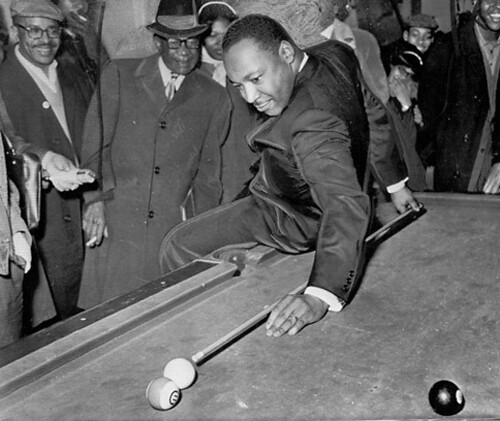
“I hope that one day, in the streets of Boston, children will look up at a statue built not only to Bill Russell the player, but Bill Russell the man.”
-Barry Obama
But Bill Russell used his position on the shoulders of athletes like Joe Louis to further their cause. He spent his adult life advocating for equality, loudly and publicly. He deserves a statue at least as much for that as for his eleven rings. It’s not a surprise that Beverly Morgan-Welch, of the Museum of African-American History, wants the statue to be of Bill Russell in a suit. She would ignore Bill Russell the player, but not for no reason. The best suggestion in the video is actually Tommy Heinsohn’s: the idea is as clumsy as the digital rendering, but his is the only suggestion that tries to encompass both parts of Russell’s greatness. To erect a statue for Bill Russell that didn’t show his proud black face would be a mistake and an insult. While a statue of Joe Louis’s fist is an elegant work of artistic metonymy because Louis broke barriers simply through proud achievement, Bill Russell fought to be acknowledged as a man, not just an athlete, and a statue of him must acknowledge that truth. To show his hands grabbing a ball would be to celebrate his glory on the hardwood, but to simultaneously deny his importance out of sneakers. It may be artistically clumsy, even hokey, for Boston’s statue of Bill Russell to be his whole body rather than just his hands, but the point of the statue is not really to be great art. It is not Bill Russell’s hands that deserve a statue, it is his brain and his heart. Any statue that fails to show that is the wrong statue.
Tuesday, May 25, 2010
The Burdens of Respect
The practice of the world goes farther in teaching us the degrees of our duty, than the subtlest philosophy, which was ever yet invented.
— David Hume, A Treatise of Human Nature
How to Shoot Somebody Who Can Outdraw You: Tom Boonen

“In fact one is tempted to ask whether there is a single man left ready, for once, to commit an outrageous folly.” – Søren Kierkegaard, The Present Age
In (team) sports, as in all human interaction, respect is one of the basic forms of currency. Any time cooperation is necessary or impediment is an option, respect gets factored into the strategic calculus. Football schemes, how much of the plate a pitcher is willing to hit, who gets double-teamed when they get the ball, whether a rider gets help on a breakaway or just drafted, all are at least partly functions of respect. The same is true of our appreciation of athletes: A-Rod and Barry Bonds1, for example, will never have their staggering achievements fully lauded because they have never quite earned the public’s respect. What athletes have the opportunity to accomplish on the field and the ramifications of such accomplishments hinge to a large degree on respect.
1: I’ve always thought it’s a shame that Barry Bonds is held in universally low respect because, before he was forever tarnished by the BALCO revelations, he had the misfortune/bad judgment to be a surly black man in a largely white game. (Sure, he was an asshole too, but still.) Go look at his numbers in his prime in San Francisco. Yes, he absolutely was using steroids, but so was a significant segment of the league, and he had four straight years with an on-base percentage over .500 while slugging .749 or better. That’s not even possible, but he was never quite recognized enough as he should have been.
In the springtime, cycle racing has its Classics season. In contrast to the grand tours, the weeks-long races where the winner is the man who grinds his opponents away through carefully-laid plans, strategic attacks, team strength and attrition, the Classics are one-day races which are won by the man willing to go hardest at the front with the best legs that day. They are full-bore, chaotic affairs in which a single misstep or mishap2 can end a rider's chances of victory. You need a strong team to put you in position to win a classic, but you can't just rely on your team like you do in a tour. By the end of the day, the front of the race is a select few riders, all trying to win, and cooperation is often key in putting yourself in a position to contend.
2: If you want misfortune, ask George Hincapie about Paris-Roubaix…
In this year's Paris-Roubaix, in some corners considered the crown jewel of the classics season, Tom Boonen fell victim to the respect in which he was held by his peers. One of the world's finest sprinters, Boonen has the power to ride away from others on a flat course like Paris-Roubaix, and as a three time former winner was one of the heavy prerace favorites. As a Belgian sprinter in a race that is a Belgian monument, he was born and built for this. His race was going as planned with about fifty kilometers left: he was in a small group of elite riders at the front of the race. Barring the truly unexpected, the winner of the race would come from the group, and Boonen was right where he needed to be.
Until he wasn't. Fabian Cancellara, a Swiss rider who is the reigning world time trial champion, attacked when Boonen was at the back of the group. He quickly gapped the group, and powered away on a long solo attack. No one else went with him, and by the time Boonen saw what was happening, Cancellara was too far gone to cross the gap.3
3: It’s worth recognizing what a ballsy move this was by Cancellara. He had faith in his ability to beat that strong group of riders over 50 km even if they took up pursuit the way Boonen wanted them to. It may have been a lapse for Boonen to be in the back of the pack, but that’s a boldly early time to launch your attack.
A quick digression on the mechanics of bicycle racing (if you're more than passingly familiar with the sport, feel free to skip this paragraph): at its physical center, bike racing is governed by two factors, aerobic capacity4 and aerodynamic drag. A rider can go as fast as his legs and lungs can propel him, but if he has no one ahead of him, he has to punch through the air ahead of him. With a rider directly before him, he can use the slipstream that rider leaves in his wake to significantly reduce how much work he has to do to travel at that speed. All cycling tactics revolve around the interplay of these two things. This is why, despite its individual prizes, cycling is a team sport.
4: This disregards the anaerobic work of sprinting, of course, but that would really be getting pedantic, wouldn’t it?
By attacking alone with fifty kilometers left in the race, then, Cancellara was taking a risk. He would have to be faster than a group of riders, taking turns pulling at the front of a paceline to spread the hard work between them, for about an hour. If any man can do it, Cancellara is that man, given the course-he is monstrously strong, and as a time trial specialist he excels at the specific agony of the discipline-but success was by no means certain. If the group he had left behind gave its all chasing him, they could well catch him.
But they didn't. They didn't catch him because they didn't try. Not because they were throwing the race, not because they didn't think they could catch him, but because of their respect for Tom Boonen. Boonen immediately began trying to organize pursuit of Cancellara, but no one would work with him. Once Cancellara attacked, Boonen needed help. As much as a group chasing Cancellara would gain from taking turns exposed to full drag, a solo pursuer, no matter how fast or fit, would have little hope of catching him after spotting him a head start. I have no idea what was said on the course, but nothing Boonen said or tried did was to any avail, and because this was a classics race he had no teammates with him to help. Every rider in that group was there because they were in a position to do well in the race; no one was riding altruistically.
So why, then, concede victory to Cancellara? Such a move only makes sense if you're terrified of Tom Boonen. The only reason you would refuse to form a chase group is if you're certain that all you'd be doing was working hard enough to hand the strongest rider in the group a victory over the others. If you don't think you can beat Boonen after a hard chase for Cancellara, whether or not you catch him, then you're only going to get second, or third if you can't catch Cancellara. If you don't chase, you may be able to beat Boonen in a field sprint, especially if he works harder than everyone else in vain hope of reeling in the attack. You won't win, but you could take second.
In other words, your respect for the abilities of Tom Boonen overrides your competitive instincts. Despite the fact that winning Paris-Roubaix would either make or burnish the career of every single rider in the group far more than a fourth would Boonen's, collectively they decided that they would rather drag race for second than turn themselves inside out for a chance to win. I'm sure it's small comfort to the man denied a chance at the win he clearly wanted badly, but it says something that professional racers in their prime quailed at facing Boonen without his making any sort of move. Any strategic decision in such a situation has to consider what all opponents might do, but to give up hope for victory without any fight at all because of what the man next to you could do speaks volumes about the esteem in which he is held. It may well have been the optimal decision for their race results, but it's competitive cowardice. At least in that race, had he been respected less by his peers, he would have had a chance to win. It's not a trap he had any way to avoid, but he was hamstrung by being so respected.
Why Don’t You Love Me Anymore: Alexandre Vinokourov

As I see it, the whole point of pragmatism is to insist that we human beings are answerable only to one another. We are answerable only to those who answer to us – only to conversation partners. We are not responsible either to the atoms or to God, at least not until they start conversing with us.
— Richard Rorty, Comments on Jeffrey Stout’s Democracy and Tradition
During a sporting event, respect matters mostly between competitors. Spectators can and do cheer and boo, but they don't tend to have too large an effect on competitive balance. After the results are in, however, imbuing them with meaning falls to the audience. Athletes decide what happens during the contest (often with an assist from chance or officiating) but the viewing public imbues these results with meaning. Consider some still consider Hank Aaron to be the baseball's home run king, or why Duke basketball (for example) is despised in so many corners. There is no such thing as an objectively meaningful result; narrative importance is constructed after the fact, consciously and not, to fit what has just happened into the framework of our fandom, biases and to connect it to history.
About a month ago, Alexandre Vinokourov won Liége-Bastone-Liége. What is remarkable about this victory is that Vino has recently returned from a two-year suspension for PEDs and seems to have not lost much riding ability at all. Where previously most suspended riders return quietly, if at all, taking their place as a diminished figure, or as part of a narrative of change/redemption a la David Millar. What sets Vino apart is that he seems to have returned to the sport at roughly the performance level he left and has never directly addressed the cause of his suspension. Any question about his reception was answered when he crossed the finish line at L-B-L victorious and was met with a chorus of boos from the fans at the finish.5
5: I wasn’t there, and I got the impression that it was a smattering of boos and no real cheering, not an overwhelming salvo of derision, but even that is a staggering reaction for a crowd at such an important race.
Vinokourov has single-handedly, in the explosive manner of all in his career, blown open the debate about the role a no-longer suspended racer can and should play in the pro peloton. He has sat out the past two years, as the rules mandate. Legally, he is once again fully qualified as a racer, but how should we, the public, feel about him? The ex-dopers who tend to get a pass are those, the David Millars of the world, who show genuine repentence for their transgression(s) and express a desire to use the rest of their career to prove what they can do clean. That seems like the natural path for someone caught in such an act: confess to the crime for which you've already been caught, and salvage what you can. I don't mean to seem overly calculating, but the zeal of the convert seems to be the sensible path for a pro who thinks they have something left and don't want to be left out as a pariah. Vino has the advantage of not having to worry about sponsorship-Astana was built for him by hometown Kazakhs, so they'll (presumably) stick with him through thick and thin. Given his secure position, he spent his time off concerned primarily with not losing his form.
By the letter of the law, he has done his time off, fulfilling his punishment and clearing his name to race. As he said in his post-race press conference, "We are here to talk about my victory. I paid two years and now I want to show I can win without doping." Absent a seemingly perfunctory "I condemn doping" at the beginning of his remarks, Vino seems to feel that, those two years being over6, he is here to talk about the present.
6: Given the career length of the world-class athlete, a two year suspension must be an unbearable eternity for the athlete to live, bereft of professional meaning.
So the question is how those external to Vinokourov react. No man believes himself to be the villain; it is the masses who condemn or exonerate. So far as I could tell, the responses to the whole brouhaha were split between outrage that such a man would be allowed to win, or at least that such a man would have the gall to be outraged at boos and mixed emotions. No one seemed interested in a full-throated defense of a man who presumably has followed all of the rules save the one he was punished for breaking. He is a man who has lost the respect he used to hold in the eyes of the amorphous audience that his peers, fans and media followers constitute.
The wrench in the works here is the impossibility of certainty regarding both the guilt for doping and repentence of the caught doper. When I say that the natural path for the caught doper is an energetic contrition, this is partially because it doesn't necessarily matter how earnest about it the player is. So long as he plays to the cameras when he returns to the public eye, avoids obviously suspicious behavior and generally keeps a low profile as a good citizen, past transgressions will be some combination of forgiven and forgotten. Vino has chosen the harder road of acting as if he has nothing left to prove after his suspension. As a result, he is stuck. As he is performing at roughly the same level he was before his suspension, the reasonable conclusion appears to be that either a) his doping didn’t help him overmuch or b) he is still doping. To view his current results as anything but suspicious requires a pretty generous interpretation of the facts we have and few onlookers seem to be so inclined. We don’t (and can’t) know what exactly he did or didn’t do and what he is or isn’t doing, so his reputation is at the mercy of collective opinion based partially on speculation.
The collective disdain of the public has no mechanism to affect competitive results, but the wisdom of the crowd does have the power to undercut a title by not considering it cleanly won. If it is decided that Vino's victory is fatally flawed because of who he is and what he represents, then there is little he can do to salvage it. He may be able to affect some degree of character rehabilitation moving forward, but it may be that,
Minerva’s Owl Flies at Dusk: Floyd Landis

“The only facts which seem genuinely independent of any scientific theory are those of the present experiences of touch, taste, smell, hearing and sight that each individual scientist is currently experiencing. But such facts are not, of course, public facts, they are private to each individual. So we have the dilemma that, if facts are truly independent of theory they are private and do not form part of the public domain of knowledge; if they are public facts they are affected by all sorts of influences particularly from previous knowledge and upon which their exact form and our confidence in them depend. At least for science, there are no brute facts.”
— Rom Harré, Philosophies of Science
When I started it, this post centered on Boonen and Vinokourov and the role respect plays in their current situations. Earlier this week, however, American pro cycling’s current prodigal sun Floyd Landis set off another earthquake when he (sort of) reversed the defiant position he’s fought for the past four years. Briefly, Landis, who has spent his time since 2006 trying to clear his name after having his Tour de France title stripped for a positive synthetic testosterone test, owned up to using EPO throughout his career and fingered pretty much every current major American cyclist for the same. Lance Armstrong’s Team Radioshack camp has responded by making public emails from Landis they say undermine his credibility, while the cycling press generally has had to come to terms with how much they believe all the parts of Landis’s confession/accusations.
Landis hasn’t truly been relevant to pro cycling since his suspension, but being an American cycling fan has required forming an opinion on his innocence/guilt. At least initially, there were enough discrepancies about his positive test that his protestations of innocence were plausible, and his dogged pursuit of a cleared name helped his case if you were inclined to believe him. He was a sympathetic enough figure that much of the money he spent chasing what he called justice in court was donated by fans.7 He was a good man wronged if you believed him or a cheater trying to game the system if you didn’t. After that, the LeMond debacle and his inability to return to professional relevancy undermined a lot of his appeal.
7: He truly was a sympathetic figure for a while: Mennonite boy grows up to become mountain bike racer through practicing against his father’s wishes, then switches to road racing and is the third American to win the Tour de France. It wasn’t too hard to want to believe him when he claimed he was the victim of a false positive.
So Landis’s new remarks are something of a neon example of the trouble that comes with any such revelations about drugs in sports. The source is a man who is about as discredited as you can be. He is not only a convicted doper and at least tacitly complicit in a blackmail attempt, but if you believe him now, he has spent years of his life in the legal pursuit of a lie. Charitably viewed, he could be a man who, after spending years under the shadow of a lie born of self-preservation, has embraced searing honesty to move forward with his life. If you don’t want to give him the benefit of the doubt, here is someone who, after years of ebbing credibility and relevance, lashes out the only way he still can, soiling names of his enemies and maybe trying to blackmail the Armstrong camp.
Landis is lying about all, some or none of this. The VeloNews summary of events, while totally accurate in its treatment of the facts, misses entirely with its conclusion. The whole point, to me, is that these accusations involve what happened seven or so years ago. I don’t see how an investigation would turn up anything new from that period now, especially not something like a positive EPO test. The scrutiny that Armstrong especially has lived under for the past decade makes it vanishingly unlikely that there is damning evidence under some unturned rock. Like any doping accusation that doesn’t revolve around a solid scientific test, there is no way to elevate the charge above hearsay. The only court that will be able to judge here is the court of public opinion.
Whatever his goals and motivations are and were, Floyd Landis is in a position where even his apologists, however many remain, will be hard-pressed to imbue his statements with much sense of credibility. If he’s telling the truth now, he’s been living a lie since 2006. It’s not knowable for those of us who weren’t on the Postal Service squad at the time just how much veracity there is in his accusations, but it’s quite certain that he has lost the respect of just about everyone in the cycling world. For the sake of Landis the man, I hope that he is now committed to being honest, no matter what, but I’m not sure there’s a road here for him to salvage any sort of good name in cycling for himself. He’s too compromised at this point, his actions are too rife with possible ulterior motives, to be trusted. He has lost the respect of his peers, the media and the fans, so unless he can produce some sort of overwhelming evidence of these salacious claims his word will never be trusted.
So What
Respect is one of the main currencies of sports.9 Wins and money are the scoreboard statistics, the concrete facts that can be gathered to settle arguments: Bill Russell is a winner because of his eleven championships; Nolan Ryan is the best strikeout pitcher ever to walk the earth. But beyond the accretion of those two things, respect is the most important thing athletes can win or lose. In competition, the respect (or lack thereof) of teammates and opponents dictates strategy, and therefore wins and losses, in games. Its impact is greater, however, outside the lines of competition. The meaning of a victory or championship is not intrinsic, but contingent on society valuing it. Lance Armstrong is a marketing force not because he won seven bike races in France, but because American sports culture, having been told that that was a (italics)big thing(/italics), respected that fact. Sports being, like any part of society, at its base a social construct, the respect of others is what drives recognition. Alexandre Vinokourov may yet earn back his good name, but only if he can succeed and keep his nose clean long enough to shift the narrative of his career arc away from its current focus on his drug suspension. Floyd Landis seems unlikely to ever find the redemption that clearly still means so much to him. Respect plays a role in who wins and who loses, but it has everything to do with whom we think of as winners and losers.
9: All right, of human society in general, but of sports no less for being a part of that.
Subscribe to:
Posts (Atom)
