Showing posts with label race. Show all posts

Monday, May 9, 2011

Let Us Now Praise Famous Men


It is a sad fact that civic art is often also pretty crappy art. This is partially due to who commissions it; an artist making a statue to appease a committee and not offend a populace is unlikely to make bold or striking choices, and said committee, when choosing from a slate of possibilities, is equally unlikely to settle upon a work that could unsettle their constituents. Civic art is nearly always safe art, and safe is one of the more damning adjectives in the art world. But civic art, especially statues honoring individual citizens, has a purpose beyond and before artistic merit. It carries a message; there is a moral to its story. There are times when the story a statue is meant to tell will by necessity limit its artistic statement, and that’s not always a bad thing.

Bill Russell is getting his statue, and it only took a magazine article and a Presidential Medal of Freedom to get Boston around to it. Rob Peterson makes the case over at Hardwood Paroxysm that the statue should be something other than the run-of-the-mill representation of a man in some artistic pose. His suggestion is Russell’s hands, rising from the earth to grasp a basketball, a sort of extension of the idea embodied in the statue of Joe Louis’s arm in Detroit.

But to honor Bill Russell with a statue of hands holding a ball is to miss half of why Bill Russell deserves a statue. Russell’s story, as Peterson makes clear, is a story of athletic glory. Wherever he went, no matter what his personal box score read, Bill Russell and his teams won: 2 NCAA Championships, 11 NBA Championships. He won 5 MVPs even though Wilt Chamberlain put up cartoonish numbers during many of the same seasons. His athletic, ball-hawking defense quite genuinely changed the way high-level basketball was played. It’s hard for those of us who weren’t alive at the time to appreciate exactly how good he was, and the grainy highlights reels of him in action, while giving glimpses of his dominance, also show just how much the game has changed since then without driving home the fact that he was perhaps the most important catalyst for that change. He is the Babe Ruth of the NBA, a living legend whose dominance defies belief. He has more rings than fingers! A hand’s worth more than MJ, current consensus GOAT! On athletic merits alone, Bill Russell deserves to have been given his statue decades ago, and Peterson’s idea of hands snaring a ball would be a fine way to commemorate that career.

But such a statue would do a disservice to Bill Russell the man. The video embedded at the top of the Globe article announcing the statue was split into two parts for a reason, with the second being dedicated to Russell the Activist. Bill Russell used his fame as a pulpit. He was a proud man, unflinching and willing to ruffle whatever feathers he had to to prove the point that he was equal to any other. He marched with King. He refused to play games in cities where the black Celtics weren’t served in restaurants. He won over the city of Boston, but he lives on an island in Seattle because he couldn’t live in a city he knew was racist. Bill Russell lived in an America that was often openly racist, and he made a point to not back down from that racism. They don’t give you the Presidential Medal of Freedom for winning NBA Championships.

Ta-Nehisi Coates wrote an article recently about how the birther media trial of Obama’s citizenship is part of a long tradition of attacks on black citizenship, and how important it is for the America that is so often excluded from portrayal to be manifested publicly. Because the past is a racist (and sexist) place, as well as because erecting statues to honor our civic heroes largely died off during the 20th century, virtually all statues in Boston (and elsewhere) commemorating people commemorate white men. Joe Louis’s fist is pointed South to signify his fight against Jim Crow laws, a symbolic alignment appropriate for a man whose very celebrity was a blow to racism. Joe Louis wasn’t a mouthpiece of civil rights because he couldn’t be. In his time, being an African-American athlete portrayed as a gentleman was transgressive enough. Aligning the fist towards the South is an elegant acknowledgment of that import.
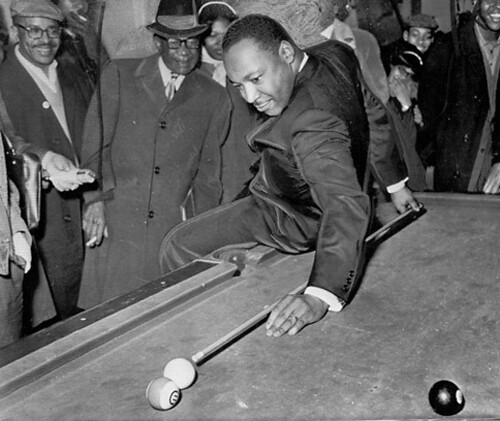

“I hope that one day, in the streets of Boston, children will look up at a statue built not only to Bill Russell the player, but Bill Russell the man.”
-Barry Obama

But Bill Russell used his position on the shoulders of athletes like Joe Louis to further their cause. He spent his adult life advocating for equality, loudly and publicly. He deserves a statue at least as much for that as for his eleven rings. It’s not a surprise that Beverly Morgan-Welch, of the Museum of African-American History, wants the statue to be of Bill Russell in a suit. She would ignore Bill Russell the player, but not for no reason. The best suggestion in the video is actually Tommy Heinsohn’s: the idea is as clumsy as the digital rendering, but his is the only suggestion that tries to encompass both parts of Russell’s greatness. To erect a statue for Bill Russell that didn’t show his proud black face would be a mistake and an insult. While a statue of Joe Louis’s fist is an elegant work of artistic metonymy because Louis broke barriers simply through proud achievement, Bill Russell fought to be acknowledged as a man, not just an athlete, and a statue of him must acknowledge that truth. To show his hands grabbing a ball would be to celebrate his glory on the hardwood, but to simultaneously deny his importance out of sneakers. It may be artistically clumsy, even hokey, for Boston’s statue of Bill Russell to be his whole body rather than just his hands, but the point of the statue is not really to be great art. It is not Bill Russell’s hands that deserve a statue, it is his brain and his heart. Any statue that fails to show that is the wrong statue.


Monday, January 4, 2010

The Second Amendment and the Third Rail


"We are like sailors who must rebuild their ship on the open sea, never able to dismantle it in dry-dock and to reconstruct it there out of the best materials." Otto Neurath, Protocol Statements


So Gilbert Arenas and Javaris Crittenton had some sort of interaction, accounts differ, involving a number of handguns in an NBA locker room. There are enough opinions floating around right now about what may or may not have happened and what Arenas/the Wizards/David Stern/the authorities should do that I’m not about to wade in with a half-cooked opinion about an event where I’m not even remotely certain just what happened. Instead, as is often my wont, I’d like to throw rocks at society.

The most level-headed response I’ve seen yet is Tom Ziller’s. His point, basically, is that the packaging of this story plays into the hands of racist views of the NBA, despite the truth of the matter, and will be used to further underline the false “NBA players are all thugs” stereotype. He’s right, and I don’t know that I’m going to turn up much here that he didn’t, but I’d like to unpack things a little more than he does.

As I’m sure you’ve noticed, with the election of Barack Obama we’re now living in an edenic postracial America. By that, of course, I mean that we live in an America that is uncomfortable with any non-glib discussion of race, and therefore avoids it at all costs. We are a society in which the obvious racist societal barriers were largely torn down roughly half a century ago. At the same time, endemic structural barriers persist in keeping ours a racially inequal society. Is there a worse hand to be dealt in America than to be born black and poor?1 Somehow, we have never found a way to talk about racial inequality without white culture feeling like it’s being called racist. There is no way to critically discuss race politics without engendering both reactionary furor from the Caucasian right wing and totally alienating non-liberal white culture as a whole.
1: I don’t mean to shortchange anyone else here; it is no better a hand to be born poor and Native American, poor and Hispanic etc. Poor and non-white would have sufficed, but today we’re talking about blackness in society.

So we pretend everything is fine. At the same time, it is the opposite of news to say that the NBA is overwhelmingly black. 76% of the league, according to the link Ziller provides.2 It is my contention that, although all of us have and make unconscious judgments of race, pure, old-fashioned conscious racism is a relatively small factor in our discourse and society. The problem is those unconscious judgments. It was one thing when the NBA was Michael Jordan and Scottie Pippen’s playhouse, with Larry Johnson’s Grandmama selling sneakers. MJ made corporate non-offensiveness cool. It’s entirely another in this post-AI age. Today’s black NBA players have no problem showing their tattoos and wearing their hair braided, if that’s who they choose to be. Subsuming yourself in white society’s picture of a non-threatening black man is no longer necessary for success. You can make it in the league without selling out your people when you’re on TV. I am absolutely not saying that the players that don’t do those things are sellouts, but it’s honest expression. This is good, but it’s also threatening as hell to the guy who lives in a suburban house and tries not to think about the inner-city because it’s hard to square it up with his America the beautiful and doesn’t really intersect with his life.
2: Would you have guessed that 22% of MLS is black? My knee-jerk read would have imagined more than 59% would be white, given the sport’s suburban popularity.

Time for a personal admission: I was, for a period in my life, a math teacher in an inner-city school in Brooklyn. I can’t claim to have a complete understanding of the life my students led, but I’ve got a decent feel for it. I don’t think white America has any fucking clue how hard it is to grow up in that environment. A lot of my students were angry young men, and even more had right to be. In the middle of a lot of American cities, kids are growing up in poverty and violence surrounded by a majority culture that doesn’t give a damn about them and won’t do a thing to help them. Listen to Tracy Morgan’s interview on Fresh Air, if you haven’t. It’s breathtaking for a number of reasons, but listen to him talk about making it. He moved out of Bed-Stuy early in the morning so that no one could see where he was moving. This is the world a lot of NBA players come from. They made it, but that also makes them a target for the people left behind. They don’t trust the police; why should they? Do you think inner-city kids and white cops have a lot of pleasant interactions? So when Devin Harris says that 75% of players own guns, it shouldn’t be surprising.

Edit: I got called out by John in the first comment for essentially making a leap from A to a sketchy C in the article. The following is an attempt to include the B I should have initially, plus a somewhat reworked conclusion.3 This is what I get for posting right before I go to bed.
3: If you’re somehow offended by this revisionism, I’d be happy to send you the original.

So a kid hits 18, and he’s a commodity. (In truth, for the vast majority of players who make it to the NBA, they’ve been a commodity since they were 14 or 16. Elite high schools and AAU teams competing for the best talent is exactly the same game as NCAA recruitment and then NBA drafting, just with less [immediately] at stake.) If you’re a basketball star, the people with whom you interact are overwhelmingly either a) looking for your attention because they’re looking for reflected fame/money/hype or b) trying to convince you to use your talents in a way that benefits them/their team. Sure, in abstract a coach has the player’s best interests in mind, but in practice he really has the team’s best interests in mind and it’ll always be easier to placate a player than to try and change his worldview unless he’s up to something truly disastrous, and the second a player is no longer useful, he may not fall off the coach’s radar but his importance goes way down. (I mean, rewatch Hoop Dreams.) Same thing in the NBA. The stars get away with a lot because they’re the stars and who’s going to call them on it, and the lower-down guys don’t get a lot of attention paid to what they do with their free time unless it’s publicly causing trouble.

This is why entourages exist. If you grew up with someone, you don’t have to worry about their credibility. They know you and are interested in you, not your brand. That alone makes it worthwhile to subsidize their living expenses. You’ve probably seen it, but take another look at the Sports Illustrated article on why pro athletes go broke. If it’s this hard to get players good advice about money, something concrete and knowable, how are you going to try and steer their worldview? If they put their cousin or friend in charge of finances, who do you think they’re going go to for advice? How do you get that kind of credibility with them?

It’s a question of trust and resources. Players coming into the NCAA/NBA from the streets have already learned a distrust of authority (again, for both good and bad reasons) and usually have already built a network of people around them whom they trust. Just because your middle-aged white coach4 is the basketball authority in your life doesn’t mean he necessarily becomes a surrogate father figure. (Even if he does, that doesn’t mean he’s necessarily teaching good lessons. For every Bob Knight5 there’s a Bob Huggins…) One-on-one, coaches probably could reach players, and sometimes do, but how many of the players on a college team do you think that happens for? At the end of the day, if the team and players are executing on the court, that’s 95% of the system’s concern. Additionally, these days the best players, the ones who are going to be the alpha dogs and set a lot of the locker room tone, are one-and-dones. Do you think they’re going to totally pour their soul into behavioral/philosophical change in that time frame with one eye on the draft? Of all the people trying to get your ear, how do you decide who to listen to? How can you be sure someone is really looking out for you if they also have a vested interest in you on the court?
4: Sure, that's a generalization, but not too much of one. One hopes that's something that starts to shift as time passes, but it should have already, and it's hard to fight the NCAA good old boy network at the level where you get started in the coaching game.
5: I'm no Bob Knight defender; he was abhorrent for a number of reasons, but he always graduated a lot of players and clearly genuinely cared about them. That doesn't defend any of the many things he did wrong, but a lot of coaches don't seem to give a shit about what their players do off the court if they avoid NCAA sanctions.


This is even more true in the pros. Suddenly the players are rich (even the rookie pay scale is rich in real terms). Coaches are looking to keep everyone out of trouble, but I’m not sure how much you can steer someone at this point. NBA culture is certainly a thing, but we’re steered by our peers, not our authority figures, especially as adults.6 If 76% of the NBA is black and the majority of those guys come from the streets, who do you think is dictating the culture?
6: And think about the player/coach dynamic. Yes, the coach builds the system and calls the plays, but players can get a coach fired and the reverse isn't very true. NBA coaches have exactly as much authority as their players decide to give them.


Players come from a culture of violence. Even if they’re not violent men, and I’m not pointing any fingers, that shapes their worldview. A lot of who we are as men is shaped by our childhood and the models of masculinity we see growing up. If you’re from a world where you can’t trust the cops and have to rely on yourself for defense, a gun seems like not just one option, but one of the most sensible. Yes, players are rich, but that means they have more at stake. This isn’t just theoretical; several athletes have been victims of violent crime precisely because they’re rich and famous and you’re an idiot if you think every other pro isn’t paying attention. Sure, statistics say that having a gun puts you at more risk, but I’m pretty sure we as a species are pretty bad at trusting statistics that run counter to what we think is true. It really shouldn’t be surprising that a culture defined by young men with this background (remember, even old pros rarely stick around the locker room past their mid-thirties.) believes strongly in gun ownership.

So Javaris Crittenton and Gilbert Arenas had guns in the locker room and had some sort of dispute with them. This is pretty clearly against DC law and Wizards policy, and they should absolutely be punished for whatever it is proven they did wrong. Having the guns in the locker room, and especially bringing them out in dispute, joke or not, was monumentally risky and stupid. That’s not really up for dispute. But neither are the reasons behind why these men had those guns. If you want to call the two of them stupid, childish or rash, feel free, though make sure you get the facts before you judge too harshly. But broader condemnation of the NBA culture should come from a position of understanding. I have no time for sanctimonious moralizing. The gun culture in the NBA isn’t an indictment of the moral fiber of the players; it’s an indictment of American society’s racial inequity. To see it as anything else is to cover your eyes.
 
Google Analytics: