Showing posts with label Kiwi fruit. Show all posts

Thursday, October 27, 2011

Victory is Sweet As When You've Known Defeat

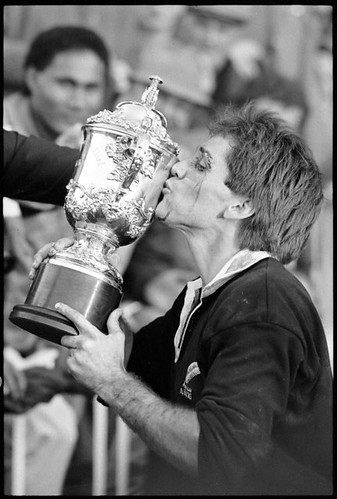
rugby-world-cup-david-kirk

Sporting droughts are funny things. They appear gradually, organically, and each accretion of failures develops its own peculiar character. Some span generations of fans raised amidst the cyclical ruins of expectations, whole communities exchanging shibboleths of hope and despair. A drought's character develops contextually: losing longer than anyone else is harsh and heavy, but losing three consecutive Super Bowls is far more interesting.

Coming into this year's Rugby World Cup, New Zealand's national side, the All Blacks, hadn't won it all in 24 years. That doesn't necessarily seem like a long time: the Red Sox waited 60 years longer than that before winning the World Series in '04; Portland has been waiting 34 years and counting for a second NBA title; England hasn't won a FIFA World cup in 45 years; Cleveland is still Cleveland, and looks to remain so for the foreseeable future. But in rugby, New Zealand is no Cleveland. The All Blacks win about 75% of all their matches. They are international rugby's leading point scorers of all time. They have a winning record and scoring margin over every test team they have ever faced.1 They have held the world #1 ranking longer than every other country combined. It's like the USA Basketball team going 24 years without winning Olympic gold, if it were also by far the most popular team in all of American sports.
1: Of those 20 teams, only 10 have even taken a single match.
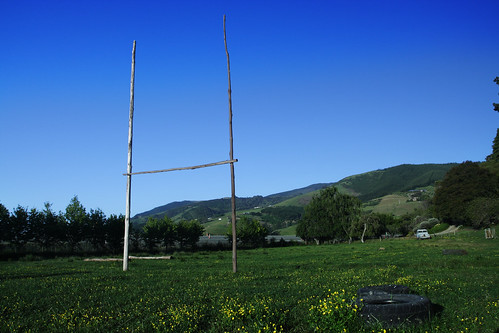
rugby posts

See, nobody but nobody loves rugby like New Zealand.2 With a population the size of metropolitan Phoenix, it supports the ITM Cup, a 14-team domestic professional championship, and five Super 15 franchises. There are 520 registered rugby clubs and 2,309 registered referees. The inaugural Rugby World Cup was co-hosted and won by New Zealand. They haven't won since3 I was for a time a preschool teacher in Wellington, NZ: I watched toddlers fight over who got to play Richie McCaw and Dan Carter; I read them "A is for All Black". So when the 2011 edition of the RWC returned to New Zealand, it's hard to overstate what a storm was stirred inside the bell jar.
2: Some Welsh will get indignant at this claim: ignore them.
3: They came closest in '95, as popularized by the movie Invictus. Not mentioned in the film was New Zealand's team-wide bout of food poisoning right before the finals. They still made it into overtime.
The All Blacks dominated the World Cup's early matches, winning their matches by an average of 38 points.4 Their closest score coming into the Finals was a 20-6 dismantling of Australia's Wallabies in the semis. They had already beaten France by 20 points in pool play. But France has always handled the All Blacks better than most anyone. Two of the All Blacks' five RWC defeats came at the hands of Les Bleus, after all. From the start, France rose to the occasion, handling the haka5 with balls7 and poise.
4: To be fair, this is somewhat distorted by their surreal dominance over Canada (79-15) and Japan (83-7). If that means nothing to you, transpose that onto American football: the two sports score on about the same scale.
5: The haka, a traditional Maori war dance with which the All Blacks begin every match, has got to be the most spectacular pre-match ritual around. Warriors traditionally performed a haka before battle to pump themselves up and intimidate the opposition. There are a variety of lyrics,6 but the All Blacks have settled on a short rotation of two. Note the face with the flared eyes (pūkana) and protuberant tongue: it originally developed as a heads up that that person intended, imminently and literally, to eat your dead body. That face is not fucking around.
6: Including this astonishingly graceless bit of cultural appropriation.
7: Non-gendered balls, of course.
The game itself was an exquisitely tense, low-scoring affair, with every kick and tackle and shift in advantage amplified by an incredibly loud, passionate crowd.8 Honestly, the rugby wasn't that amazing per se; I mean, Piri Weepu had to be subbed out in the 49th minute because he couldn't find the uprights with a map. But whatever the play lacked in execution was completely overshadowed by its importance. The atmosphere was electric. Apologies for the cliché, but it's the correct metaphor: like the bolt of a Van de Graaff generator, the game seemed liable to break in any direction at a moment's notice. And yet, by the end things had settled with remarkable diegetic clarity. The first half, the All Blacks pounded the ball in French territory, pressed in the scrums and forced a pressured French side into penalties; the second half, the French pounded the ball in kiwi territory, asserted control in the scrums, and drew penalties; each side scored one try and one kick and missed a pair of very makeable penalties.
8: Seriously, that crowd. I watched a recording of the game after the fact and to my extreme fucking chagrin got hit by a spoiler beforehand, and it still gave me goosebumps at points.
Afterwards, as a horn section played "I Vow to Thee My Country"9 on loop, the Bleus' shell-shocked captain fielded magnanimous questions about his plucky loss with numb, polite disappointment and the All Blacks exulted and hugged it out. Transcribed, the celebration seems banal; the "weight of a nation" announcing trite; the interviews about getting "quite a large monkey off your backs" asinine. But the moment itself was goddamn effulgent, a screaming, singing, laughing outpouring of people smiling so hard their faces hurt. Time is relative, and this has been a long time coming.
9: Set to the friggin' colossal theme from Holst's "Jupiter", this has got to be the most flat-out stirring piece there is. Honorable mention goes to the bassline of the Star-Spangled Banner. Why does anyone ever play it without it?

Sunday, January 3, 2010

Part Two: Editorial

What was really fascinating about this match was not the soccer qua soccer. The margins of international soccer1 are populated with countries from all over the world, grouped by the sole criterion that, whether from a lack of population or talent-recognition and -development infrastructure, their national soccer teams can't really hang with the powerhouses of Europe and South America. And so here were two culturally and racially2 distinct groups, in pleasantly iconic kits of white and red, extracted from extremely different parts of the world and placed together on a field for a totally arbitrary reason. What was really fascinating was the dynamics of that juxtaposition, both as expressed on the pitch and in the stands.
1: With the epic tenor of New Zealand's struggle to merely qualify for the World Cup tournament, the subsequent draw of the first round (to escape which New Zealand has to contend with, among others, the defending champions from Italy) somehow felt both like an total afterthought and a sobering reminder of just how far removed New Zealand still was from the World Cup trophy. It was oddly Kafkaesque.
2: I got really curious about the extent to which underlying racism informed the vitriol directed at the Bahraini players, but even if it were possible to isolate race from nationalism, homerism, magical thinking and the urge to influence the match, cultural disjoint and conceptions of masculinity (this was actually going to be the main thrust of this post, but I got sidetracked) and a good old fashioned transport of competitiveness, the handful of people I could observe directly were a few thousand short of a representative sample. I also was curious as to whether and to what degree there was a difference between the intra-team social dynamics of racially homogeneous teams like Bahrain's and racially heterogeneous teams like New Zealand's. That one doesn’t necessarily present the same sort of methodological hurdles, unless you’re stuck in the grandstands.

The most obvious and interesting difference was the different strategies of flopping3. When the Bahraini guys wanted to sell a call, they did what we tend to mean when we talk about "flopping" in soccer: they rolled around on the ground for up to ten seconds, face a rictus of pain, clutching their leg and/or head and generally making a big melodramatic fuss. You've likely seen this on television. But live, seeing the entire tableau uncropped and unframed by close-up cameras, the lurid theatricality of it is thrown into awfully sharp relief. The Kiwi players, though, practiced a sort of indirect flopping. They made an elaborate pantomime of a valiant, but futile, attempt to stand and play on through pain and/or handicap. Either one accomplishes exactly two things in soccer terms: it stops play at a point when the opposition has the tactical advantage (or at least has interfered with the current play), and it communicates a state of affairs to the referee ("I was injured in this incident") in hopes of influencing his4 call.
3: The word "flopping" has some more specific connotations, but I'm using it here more generally to refer to any of the various stratagems players use to make an opponent's last play seem dangerous, injurious, and worthy of whatever color card the ref might be considering pulling. In this sense, basically everybody flops to some degree. Anyway, I want to get away from the standard usage for two reasons: because it has an edge of moralistic disapproval which doesn't really have a place in an examination of how each team wooed the refs (we shoot for inquiry rather than inquisition here), and because I have my own angle of moralistic disapproval on which I'd like to expound a little ("shoot for" being the key term here).
4: They were all boy refs. Are there any female refs of top-level men's soccer? I can only recall having seen men, but I haven't exactly conducted a thorough study and lord knows subconscious sexism is a thing that exists.

But the Kiwi method of "indirect" flopping says something further. It offers not just a statement of fact (which can be true or false; whether or not the player is actually hurt is irrelevant to the communicative process [though not, in fact, irrelevant]) but also an interpretation, a statement of intent ("I will play on if at all possible"). And the filter of this stoic ethos completely changed my gut reaction. In comparison, the more dramatic Bahraini flopping seemed fully despicable: its essential form of lying on the ground and wailing until an authority figure took pity5 seemed narcissistic and passive-aggressive. I didn't like how, especially in the more over-the-top cases, the All Whites commensurately upped the performativeness of their disregard for what is still a potentially injured human being. There is a chance this last one was mainly in my head. And its co-optation of the body language of greater injury made for a greater degree of dishonesty. I find it far more galling to see that someone's leg is, in fact, up to full-speed soccer against professionals if they've been rolling around screaming than if they stand up with a wince and a limp and a "no worries, mate, she'll be right."
5: Having spent much of the past year working in preschools, I emphatically do not want to see this behavior from adults, too.

And I genuinely do find those things troubling. But let's back up a step or two, because what this really comes down to is conceptions of justice. Bear with me here. Stoicism is a totally reasonable expectation of people for whom justice is the responsibility of a supervisory authority, like referees or police and courts6. Those in authority enforce the codified rules; you just get on as best you can. But that's not the only game in town. From Foucault's "The Punitive Society":
"In a passage of his Lessons On Prisons, Julius contrasted civilizations of the spectacle (civilizations of sacrifice and ritual, where it is a matter of giving everyone the spectacle of a unique event and the major architectural form is the theater) with civilizations of supervision (where it is a matter of ensuring an uninterrupted control by a few over the greatest number; its privileged architectural form-- the prison). And he added that European society, which had replaced religion with the state, offered the first example of a civilization of supervision."

Now, I'm no expert on Bahraini culture (and issues of connectivity and pocket change kept me from getting my mitts on any decent scholarship on it from my local internet café), but let's run briefly with the hypothesis that, even if it could not currently be classified as a true "civilization of spectacle," its culture is less removed from one than that of a European colony. Coming from such a culture, performative demonstration of one's injury doesn't merely lose its self-indulgent quality, it assumes a necessary role within a ritualized process of justice that is concerned with "giving everyone the spectacle of a unique event".
6: Yeah, that's two authorities, but the point remains that the mechanisms of justice are out of your hands.

As for the stoic virtue of the indirect flop? From the same essay:
"[P]erhaps the most important form of the new illegality.... concerns... not so much the body of the production apparatus or that of landed property as the very body of the worker and the way in which it is applied to apparatuses of production.... The problem is then to attach workers firmly to the production apparatus... to subject them to its rhythm, to impose the constancy or regularity on them that it requires-- in short, to constitute them as a labor force.... [H]ence a whole series of measures that, without being absolutely binding, bring about a division between the good and the bad worker, and seek to ensure a behavioral rectification... hence, finally, a whole immense worker moralization campaign. This campaign defines what it wants to exorcise as 'dissipation' and what it wants to establish as 'regularity': a working body that is concentrated, diligent, adjusted to the time of production, supplying exactly the force required. It gives the marginalization effect that is due to the control mechanisms a psychological and moral status of importance."

Granted, this quote doesn't explain shit unless you identify a stoic stance towards personal injury with the "concentrated, diligent" ethos of a labor force "[attached] firmly to the production apparatus," but I don't think that's such a stretch.
 
Google Analytics: