The human capacity for attenuation is astonishing. Professional sport is a world populated by men and women who have married their end-of-the-bell-curve genetic gifts to a lifetime of purposeful practice, and thereby honed their craft to absurdly high levels. To reach a televised audience and make it at the highest level, even the fringiest players must be at the top of several pyramids of ability and effort. That we subsume this reality in our viewership of the sports we love makes sense: attention to detail at any real level would be impossible if we allowed our mind to be constantly blown by just how good everyone on the court/field is at what they do.
We unconsciously manufacture a quotidian reality for ourselves to differentiate between the great and the merely “average” or even “bad” professional athletes. The miracle of any given career is shelved to take in the entire array, to appreciate how good the best are requires that their lesser peers, no matter how badly they could school the best players you or I actually know, be considered the worst. It is neither fair nor unfair, or rather it is both. It is the lens that we inevitably manufacture for ourselves in our viewership and fandom.1
1: I think a large portion of Joe Posnanski’s success as a sportswriter with “heart”, whatever that means, is that he habitually punctures this worldview in his focus on individual actors, presenting the larger league from their point of view, rather than the converse.For an event or act to rise above the normal noise, it has to be remarkable in two different dimensions. It needs to be outside the realm of normal ability/achievement. A player or team, either through impeccable skill or tremendous luck2, seizes a moment, and leaps beyond what we think of as possible, or at least probable. The lightning strike moment of “Did I just see that!?” crystallizes exactly because it steps outside of our expectations. At the same time, it needs to carry narrative weight. An NBA ref blowing his whistle harder and louder than any of his predecessors is remarkable, but unlikely to garner a dewy ESPN special. A spectacular catch to save a run in an 8-1 baseball game will be a Web Gem, but no one will tell his or her grandchildren that (s)he was there to see it. Unlikely acts become legendary when they also drive a story. A layup to win a championship or set a scoring record is worth inestimably more than a halfcourt buzzer-beater before the half.
2: Not that the two can be teased apart neatly.And so, the No Fours team loves to figure out at the end of every year what exactly was the Exploit of the Year. As we follow whatever sport catches and holds our fancy, there is no championship to which we can point, or rubric for what makes an exploit truly worthy of note. At the same time, there is no need for our pick to be definitive. It must simply be the exploit, whether in achieving a goal or nobly failing, which electrified us the most during the previous calendar year. Oil Can Samson will unveil the winner on Thursday, but in the meantime, here are the honorable mentions.
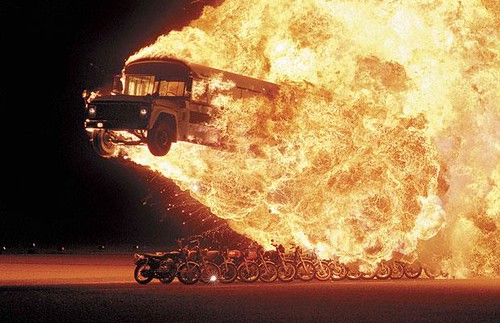
The New Zealand All Blacks Win the Rugby World Cup
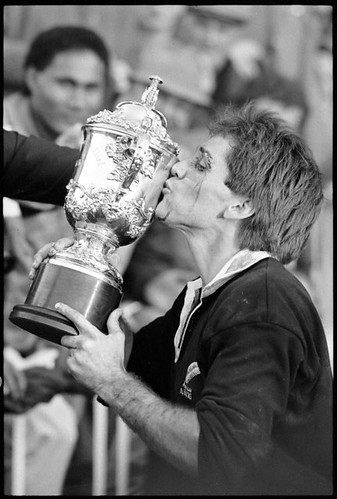
The All Blacks have a comically imposing record in international test rugby. They have won more than 75% of their matches, and have a winning record against everyone. Since the advent of world rankings in 1993, they have held the #1 ranking a full 75% percent of the time, slipping all the way down to #3 only once. Despite this, prior to 2011 they had won the Rugby World Cup only once, in its 1987 inaugural iteration. New Zealand hosted the tournament this year, and anything but victory would have been the worst blow yet for the rugger-crazed nation which had experienced a blackly comical series of defeats on the biggest stage. The All Blacks avoided that fate by storming through the tournament, demolishing their opponents en route to the finals, and then holding France at bay in a tense ultimate match that saw each side dominate one half, with the Kiwis holding on to win after storming out to a lead in the first and then struggling but succeeding in containing a resurgent France in the second. The finals were a tense but otherwise unremarkable match, and their run through the qualifying matches was dominant but not otherworldly, but no victory this year was as culturally meaningful as the All Blacks’. New Zealand hangs on rugby as much as any other country hangs on a sport, and this victory, on home soil, was redemption they had sought for years.
Thomas Voeckler’s Tour de France and Andy Schleck’s Stage 18
This year’s Tour de France was a barnburner. Instead of the Homeric saga of one man’s striving to add to his laurels against one or two challengers that we got used to when Lance ran the show, this July saw a pack of talented riders slugging it out over a mountainous course. At various points it looked like four or five men could win.
Thomas Voeckler was never a contender to win the 2011 Tour. Commemorating the centennial of the Alps’ inclusion in the race, the course was studded with steep ascents, guaranteeing that the winner would be a skinny climber, not a more solidly-built generalist like Voeckler. Nonetheless, when Voeckler wrested the yellow jersey from Thor Hushovd in a breakaway3 he absolutely turned himself inside out to defend it. He held onto it for a total of ten stages, through the Pyrenees and into the Alps.
3: The same breakaway that saw Juan Antonio Flecha struck by a car and crash into Johnny Hoogerland, sending him through a barbed-wire fence, and then both get back on their bikes and finish the stage and the entire race. You know it’s a humdinger of a race when neither of our two picks is the guy who shrugged off a violent crash and severe laceration to race on.Andy Schleck was earning a reputation as a talented shadow. Having finished second in the Tour twice, he was firmly in the circle of potential winners, but he had never shown any real instinct to attack or to press his advantage. In 2010, while his strategy of marking defending champ Alberto Contador might have worked, save for his chain slipping off, he made no aggressive moves to pass Contador. Winners get to have the story fit to their shape; losers must eventually do something gallant to be anything beyond the fastest guy who didn’t win. Schleck found himself in a similar position following stage 16 this year. Cadel Evans gained over a minute on him by gapping him on a climb and then wet descent. Schleck not only descended tentatively, but then griped to the press about conditions. As Oil Can Samson pointed out, there is no sort of talent worse than a talented coward. But in stage 18, he more than made up for his prior timidity. He attacked off the front of the field with 60 forbiddingly steep km left in the day, including the entirety of the Col du Galibier. In an age where every rider is scientifically managed to be at his peak at the exact right time and has his team’s directeur sportif in his ear via radio, this sort of move is old-fashioned. Eddie Merckx could crush the competition this way in the 70s, but no one can ride like this now. Except Andy did. He faded a little at the end of the day, and so didn’t quite unseat Voeckler from lead, but he stayed away from the field, and more than made his case. Eddie Merckx, who works for the UCI, was actively urging him on from a car behind him towards the end of the stage. Let me repeat that: a salaried employee of the sport’s governing body was using a company car to scream encouragement at him during the race, and everyone was cool with that fact because Schleck’s attack was so badass.
Voeckler, on that stage, rode himself empty to preserve his yellow jersey. He stayed with the pack over the Col d’Izoard, and despite being dropped by the real contenders on the slopes of Galibier pushed himself hard enough to retain the jersey for one more day, preserving a lead of only 15 seconds. Voeckler didn’t have what it took to win physically; he lost the maillot jaune the next day, too shattered from his effort in stage 18 to possibly defend those 15 seconds in stage 19. But in a sport where the margin between victory and defeat often is as much mental as physical, no one was harder mentally than he this year. David Millar reported seeing a broken Voeckler biking back to his team hotel after the final stage instead of riding in a team car, but of all the riders who did not win, he had the least to be ashamed of.
Dirk & Co.’s Wild Ride
When it was revealed that Jason Terry had tattooed the O’Brien trophy on his bicep before the 2010-2011 NBA season, it was evidence of serious chutzpah, but not necessarily much more than that. The Miami Heat were all but coronated before the season began, with the media talking of their impending dynasty and seriously discussing their chances of putting up the best season ever. Meanwhile, the Mavs weren’t even the favorite to win their conference. Dirk was soft, JKidd was an AARP member, JET mostly imitated airplanes after threes, and Tyson Chandler was a guy that missed Chris Paul. It was nice that the Mavs made the finals, but we’d seen this show before in 2006, and DWade’s trade of Shaq for LeBron and Chris Bosh was if anything an upgrade.
And then the Mavs won. Dirk and his crew hit a one-legged fallaway over our presumptions and criticism. When consensus has decided you don’t have a chance, the only thing to do to is to keep winning, and Dallas did. Dirk proved himself to be containable but not stoppable, Jason Kidd steered the team, JJ Barea and Terry were offensive sparkplugs, and when the confetti cleared, LeBron and his team were left with questions to answer, while Mark Cuban’s team got the trophy and the rings.
Dishonorable Mention: NBA and NFL owners
Professional sports is an odd hybrid of business and civic property. Teams are supported and emotionally owned by fanbases, manned by professional athletes who earn a paycheck, and fiscally owned and managed by rich men in suits and suites. Before national media infused them with millions of dollars, owning a team was a rich man’s pastime. Now teams are cash cows, or at least can be. In 2011, both the NFL and NBA owners collectively decided that they weren’t earning enough money, and locked out their players to get a bigger slice of the pie. In both cases it worked. The NFL owners didn’t get an 18 game season, but they crushed the player’s union without losing any game revenue. The NBA owners, on the heels of the best season the league has had in years and with bevy of young talent entering its prime, dishonestly cried poor, and were willing to lose an entire season. The 66 game demiseason left to us, though action-packed, will certainly injure some players needlessly. So, to all the owners who spent large chunks of 2011 scheming to screw players directly while being willing to screw fans indirectly, fuck you. If you're in this for the money, kindly get the hell out.