Sporting droughts are funny things. They appear gradually, organically, and each accretion of failures develops its own peculiar character. Some span generations of fans raised amidst the cyclical ruins of expectations, whole communities exchanging shibboleths of hope and despair. A drought's character develops contextually: losing longer than anyone else is harsh and heavy, but losing three consecutive Super Bowls is far more interesting.
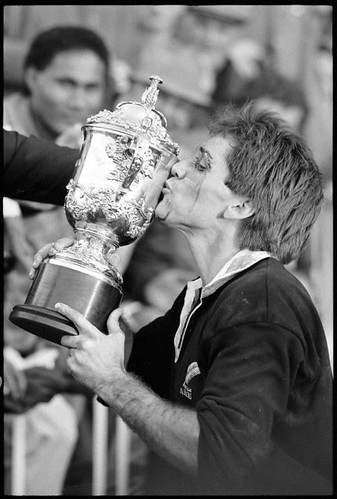
Coming into this year's Rugby World Cup, New Zealand's national side, the All Blacks, hadn't won it all in 24 years. That doesn't necessarily seem like a long time: the Red Sox waited 60 years longer than that before winning the World Series in '04; Portland has been waiting 34 years and counting for a second NBA title; England hasn't won a FIFA World cup in 45 years; Cleveland is still Cleveland, and looks to remain so for the foreseeable future. But in rugby, New Zealand is no Cleveland. The All Blacks win about 75% of all their matches. They are international rugby's leading point scorers of all time. They have a winning record and scoring margin over every test team they have ever faced.1 They have held the world #1 ranking longer than every other country combined. It's like the USA Basketball team going 24 years without winning Olympic gold, if it were also by far the most popular team in all of American sports.
1: Of those 20 teams, only 10 have even taken a single match.
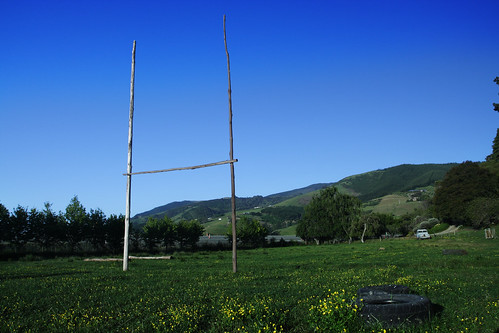
See, nobody but nobody loves rugby like New Zealand.2 With a population the size of metropolitan Phoenix, it supports the ITM Cup, a 14-team domestic professional championship, and five Super 15 franchises. There are 520 registered rugby clubs and 2,309 registered referees. The inaugural Rugby World Cup was co-hosted and won by New Zealand. They haven't won since3 I was for a time a preschool teacher in Wellington, NZ: I watched toddlers fight over who got to play Richie McCaw and Dan Carter; I read them "A is for All Black". So when the 2011 edition of the RWC returned to New Zealand, it's hard to overstate what a storm was stirred inside the bell jar.
2: Some Welsh will get indignant at this claim: ignore them.The All Blacks dominated the World Cup's early matches, winning their matches by an average of 38 points.4 Their closest score coming into the Finals was a 20-6 dismantling of Australia's Wallabies in the semis. They had already beaten France by 20 points in pool play. But France has always handled the All Blacks better than most anyone. Two of the All Blacks' five RWC defeats came at the hands of Les Bleus, after all. From the start, France rose to the occasion, handling the haka5 with balls7 and poise.
3: They came closest in '95, as popularized by the movie Invictus. Not mentioned in the film was New Zealand's team-wide bout of food poisoning right before the finals. They still made it into overtime.
4: To be fair, this is somewhat distorted by their surreal dominance over Canada (79-15) and Japan (83-7). If that means nothing to you, transpose that onto American football: the two sports score on about the same scale.The game itself was an exquisitely tense, low-scoring affair, with every kick and tackle and shift in advantage amplified by an incredibly loud, passionate crowd.8 Honestly, the rugby wasn't that amazing per se; I mean, Piri Weepu had to be subbed out in the 49th minute because he couldn't find the uprights with a map. But whatever the play lacked in execution was completely overshadowed by its importance. The atmosphere was electric. Apologies for the cliché, but it's the correct metaphor: like the bolt of a Van de Graaff generator, the game seemed liable to break in any direction at a moment's notice. And yet, by the end things had settled with remarkable diegetic clarity. The first half, the All Blacks pounded the ball in French territory, pressed in the scrums and forced a pressured French side into penalties; the second half, the French pounded the ball in kiwi territory, asserted control in the scrums, and drew penalties; each side scored one try and one kick and missed a pair of very makeable penalties.
5: The haka, a traditional Maori war dance with which the All Blacks begin every match, has got to be the most spectacular pre-match ritual around. Warriors traditionally performed a haka before battle to pump themselves up and intimidate the opposition. There are a variety of lyrics,6 but the All Blacks have settled on a short rotation of two. Note the face with the flared eyes (pūkana) and protuberant tongue: it originally developed as a heads up that that person intended, imminently and literally, to eat your dead body. That face is not fucking around.
6: Including this astonishingly graceless bit of cultural appropriation.
7: Non-gendered balls, of course.
8: Seriously, that crowd. I watched a recording of the game after the fact and to my extreme fucking chagrin got hit by a spoiler beforehand, and it still gave me goosebumps at points.Afterwards, as a horn section played "I Vow to Thee My Country"9 on loop, the Bleus' shell-shocked captain fielded magnanimous questions about his plucky loss with numb, polite disappointment and the All Blacks exulted and hugged it out. Transcribed, the celebration seems banal; the "weight of a nation" announcing trite; the interviews about getting "quite a large monkey off your backs" asinine. But the moment itself was goddamn effulgent, a screaming, singing, laughing outpouring of people smiling so hard their faces hurt. Time is relative, and this has been a long time coming.
9: Set to the friggin' colossal theme from Holst's "Jupiter", this has got to be the most flat-out stirring piece there is. Honorable mention goes to the bassline of the Star-Spangled Banner. Why does anyone ever play it without it?